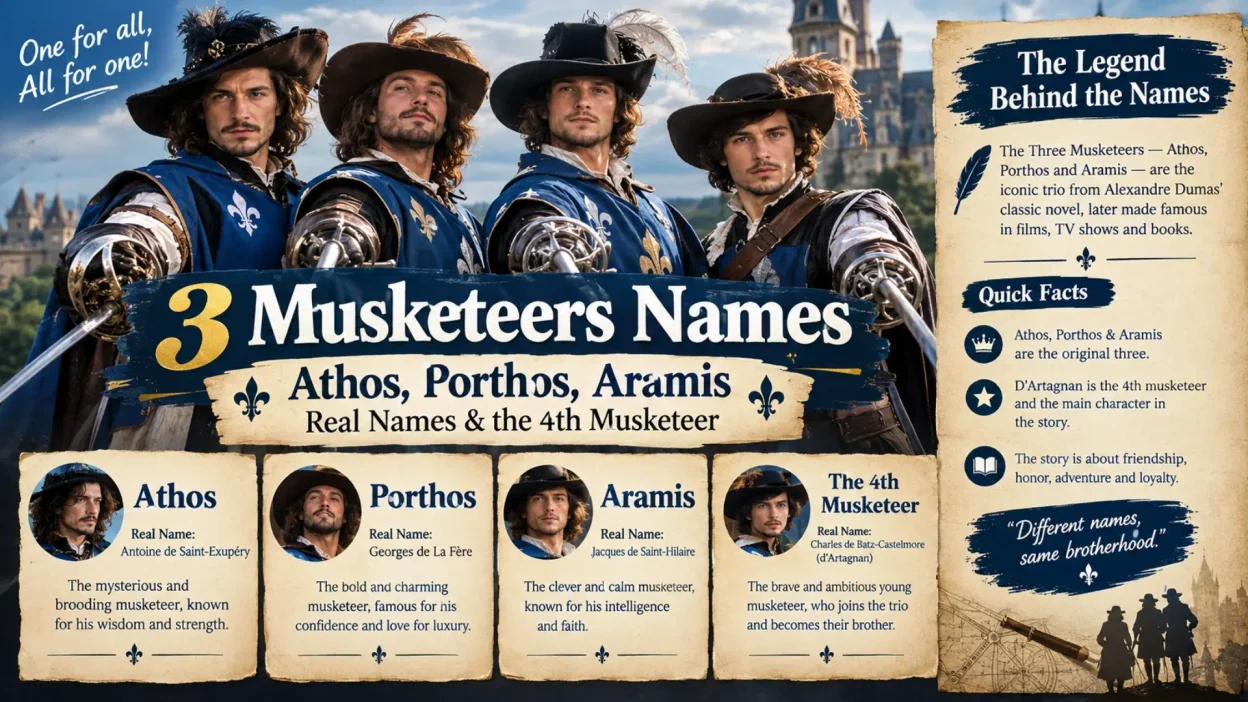
Ten readers for the three musketeers names and most will say Athos, Porthos, and Aramis, but the full answer is richer. Behind each alias is a real name in the novel, a historical musketeer who inspired Alexandre Dumas, and a story that begins with a fourth hero, d’Artagnan. This guide answers the most common questions in one place: the main trio, their real names, the real men behind them, allies and villains, Milady’s many identities, name origins, sequel timelines, and famous cast names.Skim the tables for quick answers, or read each section for the story behind the names.
Quick Answer: The three musketeers are Athos, Porthos, and Aramis. Their real names in the novels are the Comte de la Fère, Monsieur du Vallon, and René d’Herblay. The young hero d’Artagnan joins them as the fourth musketeer.
⭐ Quick Guide: The Musketeers at a Glance
| Character | Role | Name in the Novels | Real-World Inspiration |
|---|---|---|---|
| Athos | Calm, noble leader | Comte de la Fère | Armand de Sillègue d’Athos d’Autevielle |
| Porthos | Strong, vain, good-hearted | Monsieur du Vallon, later baron | Isaac de Porthau |
| Aramis | Romantic, priest-in-training | René d’Herblay | Henri d’Aramitz |
| d’Artagnan | Young hero, fourth musketeer | d’Artagnan | Charles de Batz de Castelmore |
🐴 The Three Musketeers: Athos, Porthos, and Aramis
Dumas calls the trio “the three inseparables.” All three serve in the King’s Musketeers under Captain de Tréville, and each befriends d’Artagnan after he separately offends them in Paris.
| Name | Personality | Fighting Style | Detail Worth Knowing |
|---|---|---|---|
| Athos | Shadowed, intelligent, courageous | Precise | A guard jokes his name belongs to a mountain |
| Porthos | Humorous, vain, fashion-loving | Jaunty and comical | His real first name is never given |
| Aramis | Romantic, hot-tempered, studying for the priesthood | Melodramatic | Called by his first name, René, only twice |
- Dumas published the novel in French as Les Trois Mousquetaires in 1844, writing with Auguste Maquet’s collaboration.
- The names sound mythological, but a chapter title insists the heroes are not.
- Porthos is a nom de guerre assumed when he joined the Musketeers, and Aramis also enlisted under an assumed name.
🌹 Real Names Behind the Aliases
In the sequels the friends return to their real names, which explains why the same men appear under different titles.
| Alias | Real Name in the Novels | Later Title or Role | Notes |
|---|---|---|---|
| Athos | Comte de la Fère | Lives on his estate near Blois | Husband of Milady in the backstory; father of Raoul |
| Porthos | Monsieur du Vallon | Baron du Vallon de Bracieux de Pierrefonds | First name never given |
| Aramis | René d’Herblay | Abbé or Chevalier d’Herblay; later Bishop of Vannes | Becomes a Jesuit leader |
- Dumas suggests the aliases were adopted out of caprice, discontent, or lack of fortune.
- Athos’s title, Count de la Fère, is tied to the La Fère domains in the story.
🦁 d’Artagnan: The Fourth Musketeer Explained
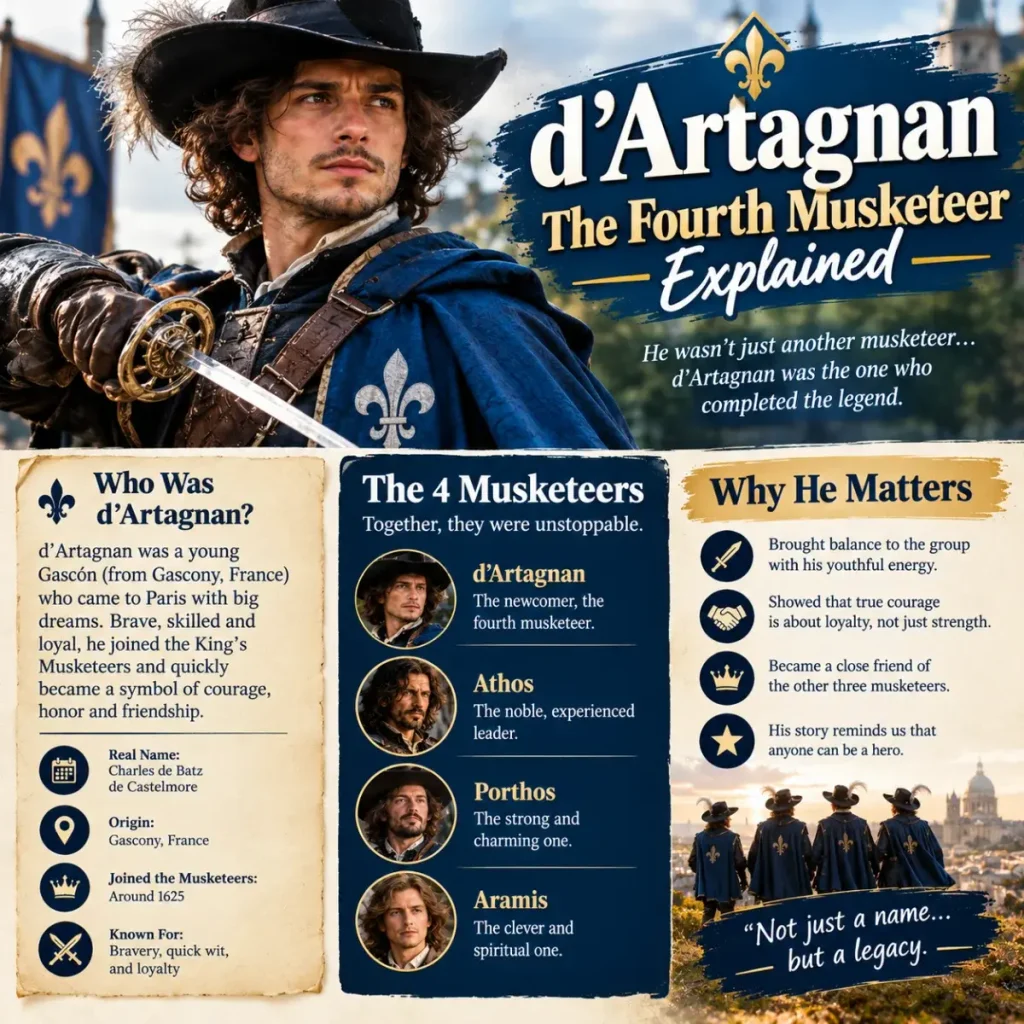
D’Artagnan is the eighteen-year-old Gascon who arrives in Paris hoping to join the Musketeers. He is brave and clever, but also impulsive and hotheaded, and he is not officially a musketeer for much of the first novel.
- He arrives on a yellow horse that Rochefort mocks.
- He falls in love with Constance Bonacieux, the queen’s lady-in-waiting.
- His loyal servant is Planchet.
- His historical inspiration is Charles de Batz de Castelmore, and Dumas drew on the Mémoires de M. d’Artagnan.
- A statue of the four musketeers by Zurab Tsereteli stands in Condom, France, in Gascony.
- The novel is the first of Dumas’s three d’Artagnan Romances.
🌿 The Real Historical Musketeers
Dumas claims he found the names in an old manuscript, though that account is fictionalised. The real men lived very different lives from their fictional namesakes.
| Fictional Hero | Historical Musketeer | What Sources Say |
|---|---|---|
| Athos | Armand de Sillègue d’Athos d’Autevielle (c. 1615 to 1643) | Born in Béarn; likely died in a duel; little in common with the character beyond the name |
| Porthos | Isaac de Porthau | Served in the Guards before joining the Musketeers |
| Aramis | Henri d’Aramitz | Noble lineage; also a lay abbot, which echoes Aramis’s priestly side |
- The three real men were called “the 3 brothers.”
- Sources differ on family links to Captain de Tréville, so treat those details as probable, not certain.
💖 Allies and Loved Ones
| Character | Role |
|---|---|
| Constance Bonacieux | The queen’s lady-in-waiting and d’Artagnan’s great love |
| Monsieur de Tréville | Captain of the King’s Musketeers and d’Artagnan’s patron |
| Planchet | d’Artagnan’s loyal, clever servant |
| Queen Anne of Austria | The unhappy queen who loves the Duke of Buckingham |
| King Louis XIII | The easily influenced king of France |
| Duke of Buckingham | English duke devoted to Queen Anne |
| Monsieur Bonacieux | d’Artagnan’s landlord and Constance’s much older husband |
| Madame de Chevreuse | The queen’s friend and Aramis’s lover |
| Lord de Winter | Milady’s brother-in-law, who helps bring her to justice |
🦊 Villains and Rivals
| Character | Role |
|---|---|
| Cardinal Richelieu | Chief minister of Louis XIII and enemy of Queen Anne |
| Comte de Rochefort | The cardinal’s agent, first met at Meung |
| Milady de Winter | Cunning agent of the cardinal and Athos’s former wife |
| Comte de Wardes | Cardinalist agent whom Milady loves |
- Milady hides a branded fleur-de-lis on her shoulder, a mark used on criminals.
- Her schemes help lead to the Duke of Buckingham’s death.
- After the murder of Constance, the musketeers judge Milady, and the executioner of Lille carries out the sentence.
- Her son Mordaunt returns in the sequels seeking revenge.
🍷 Milady’s Many Names
| Name | Context |
|---|---|
| Anne de Breuil | Her birth name, according to Dumas’s clues |
| Charlotte Backson | The name she uses after fleeing to England |
| Lady Clarick | A name taken after a likely early marriage |
| Comtesse de La Fère | Her title as Athos’s wife |
| Milady de Winter, Baroness of Sheffield | Her final married title |
“Milady” comes from the English phrase “my lady.” Some adaptations retell the story from her perspective, and in the cartoon Dogtanian and the Three Muskehounds she appears as a cat.
🌟 Name Meanings and Origins
- Athos resembles Mount Athos in Greece, which a Bastille guard jokes about in chapter thirteen.
- Mousquetaire comes from the French word for musket, an early firearm.
- The endings -os and -is give the names a Greek flavor, though Dumas says the heroes are not mythological.
- The novel describes the three young men as Béarnese in origin.
- Dumas wrote that the names struck him as likely pseudonyms.
- Their motto, “All for one and one for all,” captures the loyalty at the story’s heart.
🌳 Sequel Timeline: Twenty Years After and Beyond
| Book | What Happens to the Names |
|---|---|
| The Three Musketeers | Athos, Porthos, Aramis, and d’Artagnan form the famous foursome |
| Twenty Years After | The friends have resumed real names: Athos near Blois, Porthos married to a rich lawyer’s widow, Aramis a priest; Raoul and Mordaunt appear |
| The Vicomte de Bragelonne | Porthos becomes a baron and dies in a cave; Aramis rises to Bishop of Vannes and Jesuit General |
🎉 Adaptations and Cast Names
| Production | Character | Actor |
|---|---|---|
| 2011 film (directed by Paul W.S. Anderson) | d’Artagnan | Logan Lerman |
| 2011 film | Athos | Matthew Macfadyen |
| 2011 film | Porthos | Ray Stevenson |
| 2011 film | Aramis | Luke Evans |
| 2011 film | Milady | Milla Jovovich |
| 1933 French film | Athos | Henri Rollan |
| The Return of the Musketeers | Justine de Winter | Kim Cattrall |
The 2011 cast also included Orlando Bloom, Christoph Waltz, and Mads Mikkelsen. Cast names vary by adaptation, so always check the specific production.
🌻 Fun Facts
- The story begins in 1625, during the reign of Louis XIII.
- The Siege of La Rochelle appears among the novel’s major events.
- Cardinal Richelieu, Louis XIII, and Anne of Austria are real historical figures.
- Musketeer origins trace back to light cavalry units called carabins, formed around 1600.
- The trio’s names have become shorthand: Athos for noble dignity, Porthos for jovial strength, Aramis for romantic strategy.
🍀 How to Remember the Names
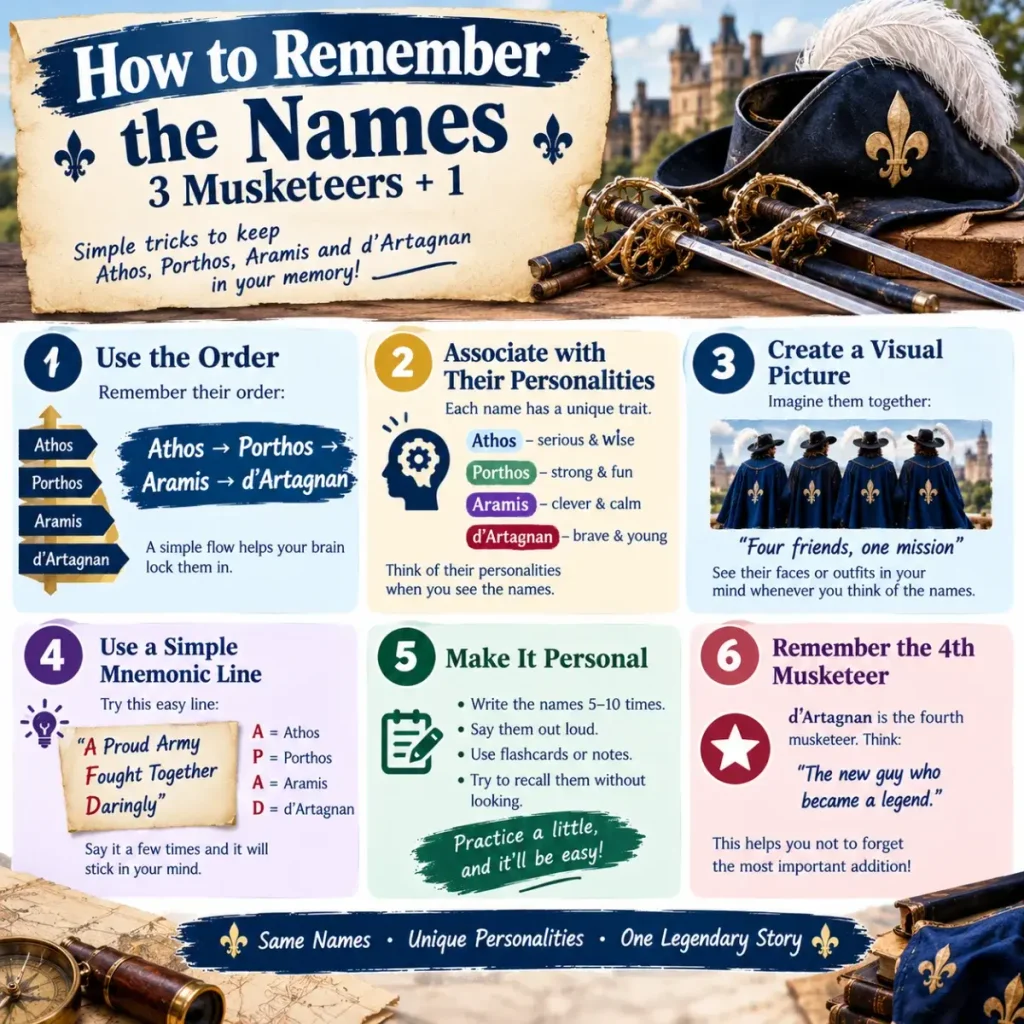
- Think leader, power, and amour: Athos, Porthos, Aramis.
- Pronounce Athos as ah-TOHS, Planchet as plahn-SHAY, and Richelieu as reesh-LYEW.
- Make flashcards that pair each alias with its real name.
- Draw a character map linking friends, allies, and enemies.
- Verify historical details in reliable sources before publishing them.
FAQs
What are the three musketeers names?
The three musketeers are Athos, Porthos, and Aramis. The young hero d’Artagnan joins them and is often called the fourth musketeer.
Who is the fourth musketeer?
The fourth musketeer is d’Artagnan, an eighteen-year-old Gascon who travels to Paris hoping to join the King’s Musketeers. He becomes the trio’s closest friend.
What are the real names of Athos, Porthos, and Aramis?
In the novels, Athos is Comte de la Fère, Porthos is Monsieur du Vallon (later a baron), and Aramis is René d’Herblay. Porthos’s first name never given.
Were the three musketeers real people?
Dumas based them loosely on historical musketeers Armand d’Athos, Isaac de Porthau, and Henri d’Aramitz. The fictional characters heavily dramatized, real men had different live.
What is the motto of the three musketeers?
Their famous motto is “All for one and one for all.” It sums up the loyalty and friendship at the center of the story.
What are Milady de Winter’s real names?
Milady believed to be born Anne de Breuil. She also uses the names Charlotte Backson, Lady Clarick, Comtesse de La Fère, and Milady de Winter, Baroness of Sheffield.
Conclusion
The 3 musketeers names open a surprisingly deep world, from Athos, Porthos, and Aramis to their real names, historical inspirations, and the fourth hero d’Artagnan. This guide covered the main trio, allies and villains, Milady’s many identities, name origins, the sequel timeline, adaptations, and simple tips for remembering everyone.
Where details are uncertain, treat them with care and confirm them in reliable sources. A story built on loyalty, adventure, and memorable names stays fresh across centuries, which is why readers keep returning to it. Save this guide, share it with a fellow fan, and keep exploring Dumas’s world.

Jack Sullivan is a passionate writer and content creator who loves exploring unique names, creative ideas, and interesting stories. He creates engaging, helpful, and easy-to-read content for NameZeria.com.