
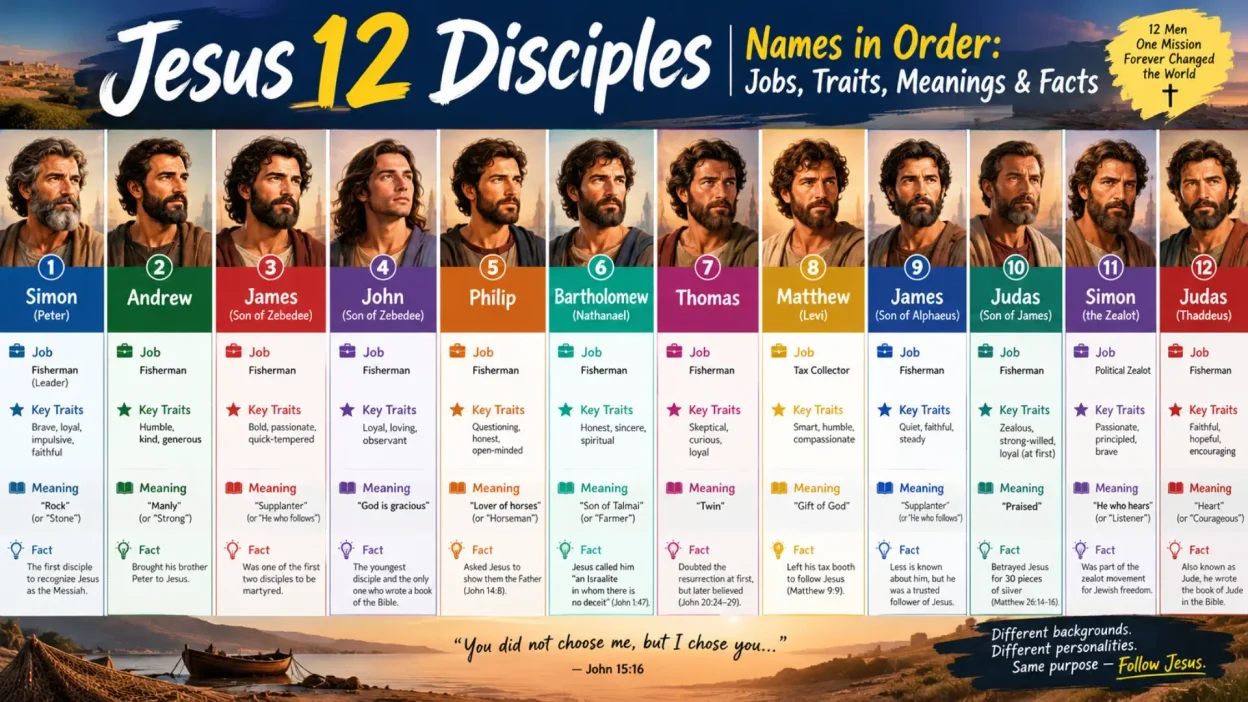
Many readers search for Jesus 12 disciples names and quickly discover that the answer has a few interesting twists. Several men had two names, the Gospel lists differ slightly, and one disciple later replaced. This guide gives the complete list in order, with jobs, personality traits, name meanings, alternate names, and the story of Judas and Matthias. All lists are based on Matthew 10:2–4, Mark 3:16–19, Luke 6:13–16, and Acts 1:13.
You will also learn the difference between disciples and apostles, what the Bible says about how they died, and what church tradition adds. If you enjoy this topic, you can explore more bible names afterward. Where history is uncertain, the guide says so clearly and separates Scripture from later tradition.
Quick Answer: The twelve disciples were Simon Peter, Andrew, James son of Zebedee, John, Philip, Bartholomew, Thomas, Matthew, James son of Alphaeus, Thaddaeus, Simon the Zealot, and Judas Iscariot (Matthew 10:2–4). After Judas, Matthias became the twelfth (Acts 1:26).
⭐ Quick Guide: The Twelve at a Glance
| # | Disciple | Also Known As | Background |
|---|---|---|---|
| 1 | Simon Peter | Cephas | Fisherman; first in every list |
| 2 | Andrew | None recorded | Fisherman; Peter’s brother |
| 3 | James son of Zebedee | Son of Thunder | Fisherman; John’s brother |
| 4 | John | Son of Thunder | Fisherman; traditionally the beloved disciple |
| 5 | Philip | None recorded | From Bethsaida |
| 6 | Bartholomew | Nathanael | Brought to Jesus by Philip |
| 7 | Thomas | Didymus (twin) | Known for doubt, then faith |
| 8 | Matthew | Levi | Tax collector |
| 9 | James son of Alphaeus | James the Less | Few details recorded |
| 10 | Thaddaeus | Judas son of James | Name varies across lists |
| 11 | Simon the Zealot | Simon the Canaanite | Linked to zealot movement |
| 12 | Judas Iscariot | None recorded | Treasurer who betrayed Jesus |
🐟 The First Four: Peter, Andrew, James, and John
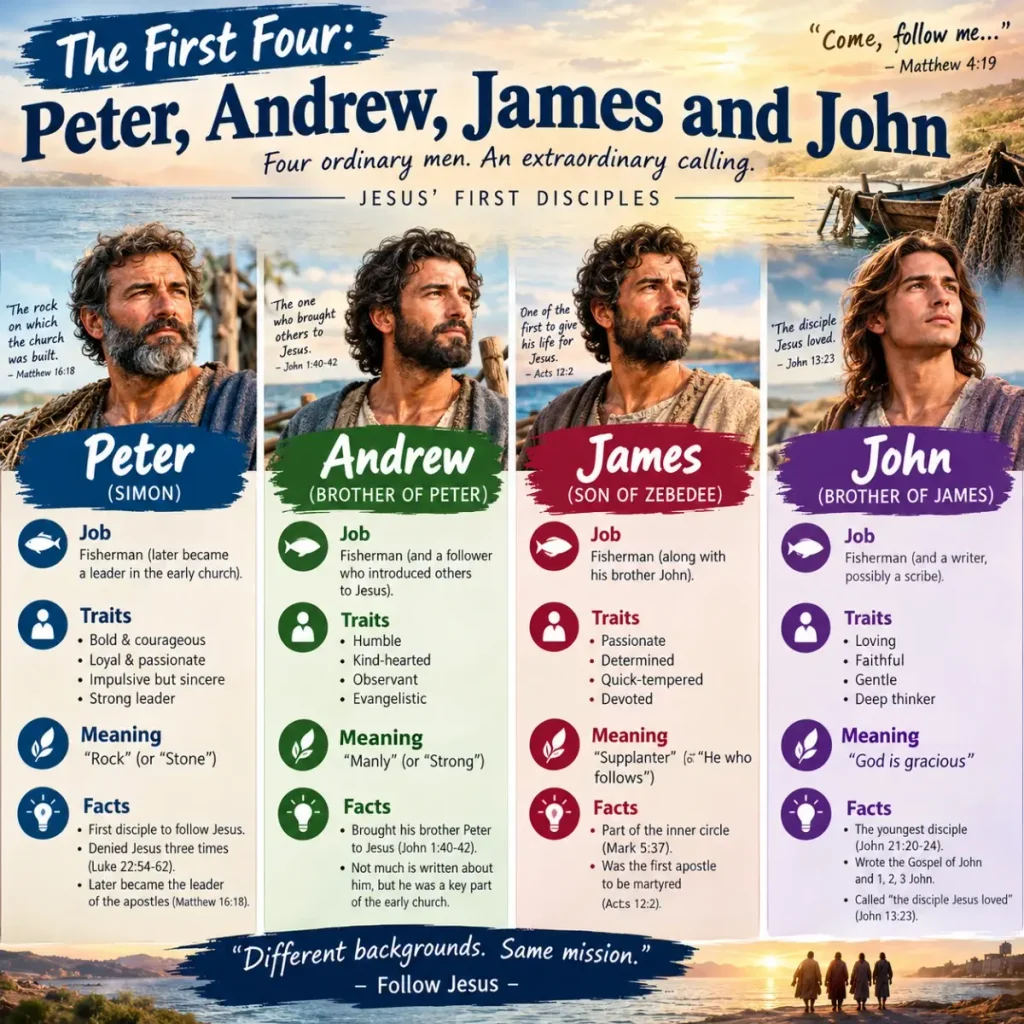
The first four disciples were two pairs of fishermen brothers from the Galilee region.
- Simon Peter was a fisherman, named first in every list of the twelve.
- Jesus called Simon “Cephas,” the Aramaic form of Peter, meaning rock.
- Andrew, Peter’s brother, first followed John the Baptist before meeting Jesus.
- Andrew brought Peter to Jesus, according to John 1:40–42.
- Peter and Andrew came from Bethsaida in Galilee, according to John 1:44.
- James and John were fishermen, sons of Zebedee.
- James and John left their boat and father to follow Jesus.
- Jesus nicknamed James and John “Boanerges,” meaning Sons of Thunder.
- Peter, James, and John formed Jesus’s inner circle.
- Peter mentioned more New Testament than other disciples.
- James’s death by Herod’s sword recorded in Acts 12:2.
- John traditionally identified the disciple whom Jesus loved.
- Matthew, Mark, and Luke place these four first among those called.
🌿 Philip, Bartholomew, Thomas, and Matthew
These four are paired in Matthew’s list: Philip with Bartholomew, and Thomas with Matthew.
- Philip was from Bethsaida, the same town as Peter and Andrew.
- Jesus found Philip and said “Follow me” in John 1:43.
- Philip then found Nathanael and invited him to meet Jesus.
- Nathanael is usually identified with Bartholomew in the Synoptic lists.
- Bartholomew means “son of Talmai,” so it may be a family name.
- Jesus called Nathanael an Israelite without deceit in John 1:47.
- Thomas is also called Didymus, which means “twin.”
- Thomas is best known for doubting until he saw the risen Jesus.
- Matthew was a tax collector when Jesus called him.
- Mark and Luke call Matthew by the name Levi.
- Matthew left his tax booth immediately to follow Jesus.
- Matthew’s Gospel lists the twelve in chapter 10, grouped in pairs.
- Matthew is traditionally credited with writing the first Gospel.
🍇 James, Thaddaeus, Simon, and Judas Iscariot
The last four names in Matthew’s list are the most likely to appear under different titles.
- James son Alphaeus called James the Less.
- The title may distinguish him from James son of Zebedee.
- Little recorded James son of Alphaeus Gospels.
- Thaddaeus called Judas, son of James, in Luke.
- Some manuscripts of Matthew 10:3 mention Lebbaeus for Thaddaeus.
- John 14:22 mentions “Judas (not Iscariot),” often linked to Thaddaeus.
- Simon Zealot called Simon the Canaanite in Mark 3:18.
- “Zealot” may point to a revolutionary movement or religious zeal.
- Judas Iscariot listed last three Gospel lists.
- Iscariot likely means “man of Kerioth,” though scholars debate it.
- Judas managed the group’s money bag, according to John 12:6.
- Judas betrayed Jesus for thirty pieces of silver in Matthew 26:15.
- Matthew 27 and Acts 1 describe Judas’s death differently.
🌟 Alternate Names and Why the Lists Differ
The differences are small, and ancient writers often used more than one name for the same person.
- Four New Testament passages list the twelve: Matthew, Mark, Luke, and Acts.
- The order of names differs slightly between the passages.
- Simon Peter always appears first, and Judas Iscariot is last in the Gospel lists.
- Acts 1:13 lists only the eleven remaining apostles after Judas.
- Bartholomew appears in every list and matched with Nathanael.
- John’s Gospel never names Bartholomew, but names Nathanael instead.
- Thaddaeus, Lebbaeus, and Judas son of James likely describe one man.
- Simon Zealot named Simon Canaanite.
- Matthew called Levi in Mark and Luke.
- Some suggest James and Matthew were brothers, are called sons of Alphaeus.
- Common names like Simon, James, and Judas made second names helpful.
- All four Gospels share eight of the twelve names.
- Differences among lists are minor and do not change the group’s identity.
💖 Name Meanings and Nicknames
Meanings come from Hebrew, Aramaic, and Greek, and a few remain debated. For more bible names with meanings, or names from ancient mythology such as goddess names, see our related guides.
- Peter and Cephas both mean rock, in Greek and Aramaic.
- Andrew a Greek name often explained as “manly” or “brave.”
- James is the English form of the Hebrew name Jacob.
- John comes from a Hebrew name meaning “God is gracious.”
- Philip is a Greek name meaning lover of horses.
- Bartholomew means “son of Talmai,” showing a family connection.
- Thomas means twin in Aramaic, and Didymus means twin in Greek.
- Matthew comes from a Hebrew name meaning “gift of God.”
- Simon linked to a Hebrew word meaning “he has heard.”
- Judas is the Greek form of Judah, meaning “praised.”
- Thaddaeus has a debated meaning, so sources vary.
- Boanerges means “Sons of Thunder,” given to James and John.
- Iscariot probably points to Kerioth, though scholars still debate it.
🍞 Jobs and Backgrounds Before Following Jesus
The twelve came from ordinary work and very different life experiences.
- Peter, Andrew, James, and John worked as fishermen on Galilee.
- Matthew collected taxes, a job many neighbors disliked.
- Simon the Zealot may have belonged to a revolutionary movement.
- Philip came from Bethsaida, a fishing town near the sea.
- Nathanael came from Cana in Galilee, according to John 21:2.
- Most of the twelve were Galileans, while Judas was likely from Judea.
- The Gospels do not state jobs for several of the twelve.
- Jesus chose ordinary men without formal religious or political power.
- Matthew and Simon the Zealot likely came from opposite political backgrounds.
- Jesus called fishermen to become “fishers of men” in Matthew 4:19.
- Their varied backgrounds show Jesus’s message reached many kinds of people.
🌅 The 12 Disciples in Order of Calling
John’s Gospel and the Synoptic Gospels describe the callings in slightly different ways.
- Andrew and another disciple first followed Jesus in John 1:35–40.
- The other disciple is traditionally identified as John.
- Andrew then brought his brother Simon to Jesus.
- Jesus renamed Simon “Cephas,” meaning rock, in John 1:42.
- Jesus found Philip the next day in John 1:43.
- Philip found Nathanael, who is usually identified as Bartholomew.
- James and John were called while mending nets with their father.
- Matthew was called while sitting at his tax booth.
- Peter and Andrew’s calling appears in Matthew 4:18–20.
- Jesus formally chose the twelve after praying all night on a mountain.
- He selected twelve from a larger group of followers in Luke 6:12–13.
- Calling order differs between John and the Synoptic Gospels.
🦁 Personality Traits and Characteristics of Each Disciple
The Gospels show these men as real people with strengths, doubts, and growth.
- Peter: bold and impulsive, yet he became a leader of the early church.
- Andrew: quiet and welcoming, known for introducing others to Jesus.
- James: passionate and zealous, nicknamed a Son of Thunder by Jesus.
- John: devoted and close to Jesus, traditionally the beloved disciple.
- Philip: practical and curious, often asking how things would work.
- Bartholomew: honest and direct, with sincere questions about Jesus.
- Thomas: honest about his doubts, then boldly confessed his faith.
- Matthew: willing to leave a profitable career to follow Jesus.
- James son of Alphaeus: a quiet figure with very few recorded details.
- Thaddaeus: asked a thoughtful question about Jesus’s revelation in John 14:22.
- Simon the Zealot: passionate by background, joining a very diverse team.
- Judas Iscariot: trusted with money, yet chose betrayal over loyalty.
- Peter, James, and John formed the inner circle at key moments.
- They witnessed the Transfiguration, Jairus’s daughter, and Gethsemane together.
🕊️ Judas Iscariot and Matthias: The Replacement
Acts 1 explains how the group returned to twelve after Judas died.
- Judas Iscariot betrayed Jesus to the chief priests.
- Matthew 26:15 mentions thirty pieces of silver as the payment.
- Matthew 27:5 says Judas hanged himself after his regret.
- Acts 1:18 describes his death differently, mentioning a field.
- After the ascension, the eleven remaining apostles needed a replacement.
- Peter explained the need to replace Judas in Acts 1:15–22.
- The candidate had to have followed Jesus from his baptism onward.
- The group prayed, then drew lots to choose between them.
- The lot fell to Matthias, who joined the eleven.
- Matthias becomes the twelfth apostle in Acts 1:26.
- Later traditions about Matthias’s ministry vary and remain uncertain.
🐑 Disciples vs Apostles: What Is the Difference?
The words overlap, which is why people often confuse them.
- Disciple means a learner or follower of a teacher.
- Many people followed Jesus as disciples during his ministry.
- Jesus selected twelve from that wider group to be apostles.
- Luke 6:13 says Jesus called his disciples and named twelve apostles.
- The Gospels often use disciples and apostles for the same twelve.
- After the resurrection, the title apostle gained wider use.
- Paul claimed the title apostle after meeting the risen Jesus.
- Paul, however, was not one of the original twelve.
- Barnabas is also called an apostle in the book of Acts.
- Women followers, such as Mary Magdalene, were disciples but not among the twelve.
- The twelve held a special teaching and witness role.
- Using both words correctly avoids confusion in Bible study.
🌳 How the Twelve Died: Bible vs Tradition
The Bible records only two deaths, so most details come from later church tradition and should be read with care.
- The Bible records the deaths of only two of the twelve.
- James son of Zebedee died by the sword in Acts 12:2.
- Judas Iscariot’s death is described in Matthew 27 and Acts 1.
- Other details come from church tradition, not Scripture.
- Tradition says Peter was crucified in Rome under Nero.
- Tradition adds that Peter was crucified upside down.
- Andrew is traditionally said to have been crucified in Patras, Greece.
- The X-shaped cross detail for Andrew appeared much later.
- Thomas is traditionally said to have died in India by a spear.
- Bartholomew’s martyrdom accounts conflict, including a tradition of being flayed.
- Matthew is remembered as a martyr, though the method is disputed.
- Tradition about James son of Alphaeus is limited and uncertain.
- Treat martyrdom details as tradition unless early evidence supports them.
🍀 Why Twelve? Meaning and Memory Tips
The number twelve carries symbolic weight, and a simple pattern makes the names easy to remember.
- Twelve likely echoes the twelve Clan of Israel.
- Jesus mentions twelve thrones judging Israel’s Clan in Matthew 19:28.
- The number made the group a symbol of renewed Israel.
- Memorize the list in pairs, following Matthew 10:2–4.
- Start with the fishermen: Peter, Andrew, James, and John.
- Next learn Philip, Bartholomew, Thomas, and Matthew in that order.
- Finish with James, Thaddaeus, Simon, and Judas Iscariot.
- Link Peter with rock, Thomas with twin, and Matthew with tax collector.
- Mark alternate names beside each disciple, such as Nathanael and Levi.
- Compare Mark 3, Luke 6, and Acts 1 to see differences.
- Practice saying the list aloud until it feels natural.
- Teach the twelve names to children with simple flashcards.
- Read primary Bible passages rather than relying only on summaries.
FAQs
What are the names of Jesus’s 12 disciples (the 12 apostles)?
They are Simon Peter, Andrew, James son of Zebedee, John, Philip, Bartholomew, Thomas, Matthew, James son of Alphaeus, Thaddaeus, Simon the Zealot, and Judas Iscariot (Matthew 10:2–4).
Who replaced Judas Iscariot?
Matthias replaced Judas. After prayer, the apostles drew lots, and the lot fell to Matthias, who joined the eleven (Acts 1:26).
What is the difference between disciples and apostles?
A disciple is a follower or learner, while an apostle is one who is sent. Jesus chose twelve from his wider group of disciples to be apostles.
Which disciples had more than one name?
Simon Peter was also Cephas, Bartholomew is usually Nathanael, and Matthew was also Levi. Thaddaeus is called Judas son of James, Thomas was Didymus, and Simon the Zealot the Canaanite.
How did the 12 disciples die?
The Bible records only James (Acts 12:2) and Judas. Other accounts, such as Peter’s crucifixion in Rome and Thomas’s death in India, come from church tradition.
Why did Jesus choose twelve disciples?
Twelve likely echoes the twelve Clan of Israel, symbolizing a renewed people of God. Jesus also mentions twelve thrones judging the Clan in Matthew 19:28.
Conclusion
The Jesus 12 disciples names are more than a list: they reveal fishermen, a tax collector, a zealot, and a betrayer called to follow one teacher. This guide covered the full list in order, alternate names, name meanings, jobs, calling order, personality traits, Judas and Matthias, the difference between disciples and apostles, and what Scripture and tradition say about how they died.
Where details are uncertain, treat them with care and return to the Bible passages for the clearest picture. If you enjoy exploring name meanings, continue with more bible names or discover goddess names from ancient traditions. Save this guide, use it for study or teaching, and pass it along to someone exploring the Gospels.
“Sources By: Matthew 10, Mark 3, Luke 6, Acts 1”

Jack Sullivan is a passionate writer and content creator who loves exploring unique names, creative ideas, and interesting stories. He creates engaging, helpful, and easy-to-read content for NameZeria.com.