
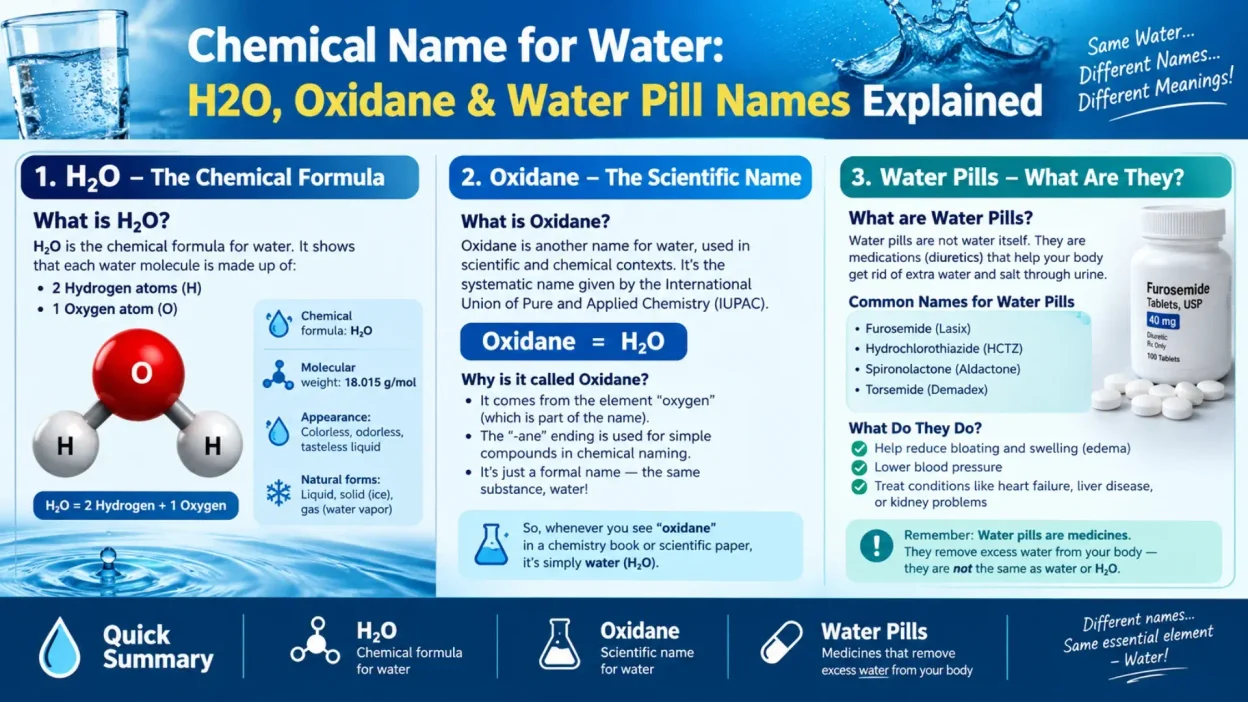
Few questions sound simpler than asking for the chemical name for water, yet the answers range from H2O to oxidane and even the famous joke name dihydrogen monoxide. This guide explains every name clearly, starting with the formula, the systematic names, and the look-alike compounds students often confuse. You will also learn everyday water type names, the scientific names for water’s states, and simple study tips.
Because many readers also search for water pill names, a separate section explains diuretic classes and common examples in plain language, with safety reminders. Start with the quick table, then jump to the section you need. Every point is short, checked against chemistry and medical references, and easy to share.
🌟 Quick Guide: Water’s Names at a Glance
| Topic | Quick Answer | Examples |
|---|---|---|
| Chemical name for water | H2O, with systematic names such as oxidane | Water, oxidane, hydrogen oxide |
| H2O water chemical name | Two hydrogen atoms and one oxygen atom | H2O |
| Dihydrogen monoxide | A joke name for ordinary water | Same as water |
| Look-alike compounds | Different substances with similar names | D2O, H2O2 |
| Everyday water types | Labels based on source and treatment | Tap, spring, distilled |
| Water states | Scientific names for each form | Ice, liquid water, vapor |
| Water pill names | Diuretic classes and examples | Furosemide, hydrochlorothiazide, spironolactone |
| Safety | Ask a healthcare professional first | Never start or stop alone |
💧 Chemical Name for Water Explained
- 💧 Water is the common name for the compound with formula H2O.
- 🌊 IUPAC accepts water as the everyday name for H2O.
- 🌟 Oxidane is the systematic name listed for water by IUPAC.
- ⭐ Hydrogen oxide is another accepted chemical name for water.
- 🌿 Dihydrogen oxide appears as a synonym on many laboratory product pages.
- 🍀 Dihydrogen monoxide names water by counting its hydrogen and oxygen atoms.
- 🌈 Chemists identify water with the CAS registry number 7732-18-5.
- 🌻 PubChem files water under compound identifier 962 for easy database searching.
- 💖 Water’s molar mass is about 18 grams per mole.
- 🐬 Distilled, deionized, and purified water are lab names for treated water.
- 🐚 Textbooks usually prefer the simple name water over long alternatives.
- 🌊 Systematic names matter most in laboratories, labels, and formal chemistry classes.
- 💧 Aqua is a Latin-based word that appears in many scientific terms.
- 🌿 Aqueous means dissolved in water, as in an aqueous solution.
- ⭐ For everyday writing, calling it water is clear and correct.
🍀 H2O Water Chemical Name: Formula and Structure Facts
- 🍀 H2O means each molecule has two hydrogen atoms and one oxygen atom.
- 💧 The small number 2 shows how many hydrogen atoms are present.
- 🌊 Water molecules are bent, with an angle near 104.5 degrees.
- 🌟 Oxygen pulls electrons strongly, giving water a slightly negative side.
- ⭐ That polarity lets water dissolve many salts and sugars.
- 🌿 Hydrogen bonds hold water molecules together and create surface tension.
- 🌈 Pure water freezes at zero degrees Celsius at standard pressure.
- 🌻 Pure water boils at one hundred degrees Celsius at sea level.
- 💖 Ice floats because frozen water is less dense than liquid water.
- 🐬 Water covers most of Earth’s surface, mostly as salty ocean water.
- 🐚 Living cells depend on water for chemical reactions and transport.
- 🌊 Water is often called the universal solvent, although not for everything.
- 💧 Pure water is a poor electrical conductor, while salty water conducts well.
- 🌿 Seawater contains dissolved salts, so it is not just H2O.
- ⭐ Chemistry teachers often write the formula as H2O, with a subscript two.
🌿 Dihydrogen Monoxide: The Famous Science Joke
- 🌿 Dihydrogen monoxide is simply another name for ordinary water.
- 💧 The name sounds scientific, which makes water seem frightening.
- 🌊 Internet memes use the name to make drinking water sound dangerous.
- 🌟 The joke works because the scary facts are technically true of water.
- ⭐ Water can drown people, which is the joke’s most famous warning.
- 🍀 Breathing water into the lungs is dangerous, as the meme hints.
- 🌈 Water is also essential for life, which memes often skip.
- 🌻 Classroom activities use the name to teach critical thinking about labels.
- 💖 Chemistry teachers like it as a gentle lesson in naming rules.
- 🐬 The prefix di means two, and mono means one.
- 🐚 The same prefix pattern names carbon monoxide and carbon dioxide.
- 🌊 Dihydrogen monoxide is not heavy water, despite what some forums claim.
- 💧 Always read context before panicking about a chemical-sounding name.
- 🌿 Fact-checking labels is a useful habit for any science reader.
- ⭐ The name is accurate but impractical outside jokes and classrooms.
🐬 Heavy Water, Hydrogen Peroxide, and Other Look-Alikes
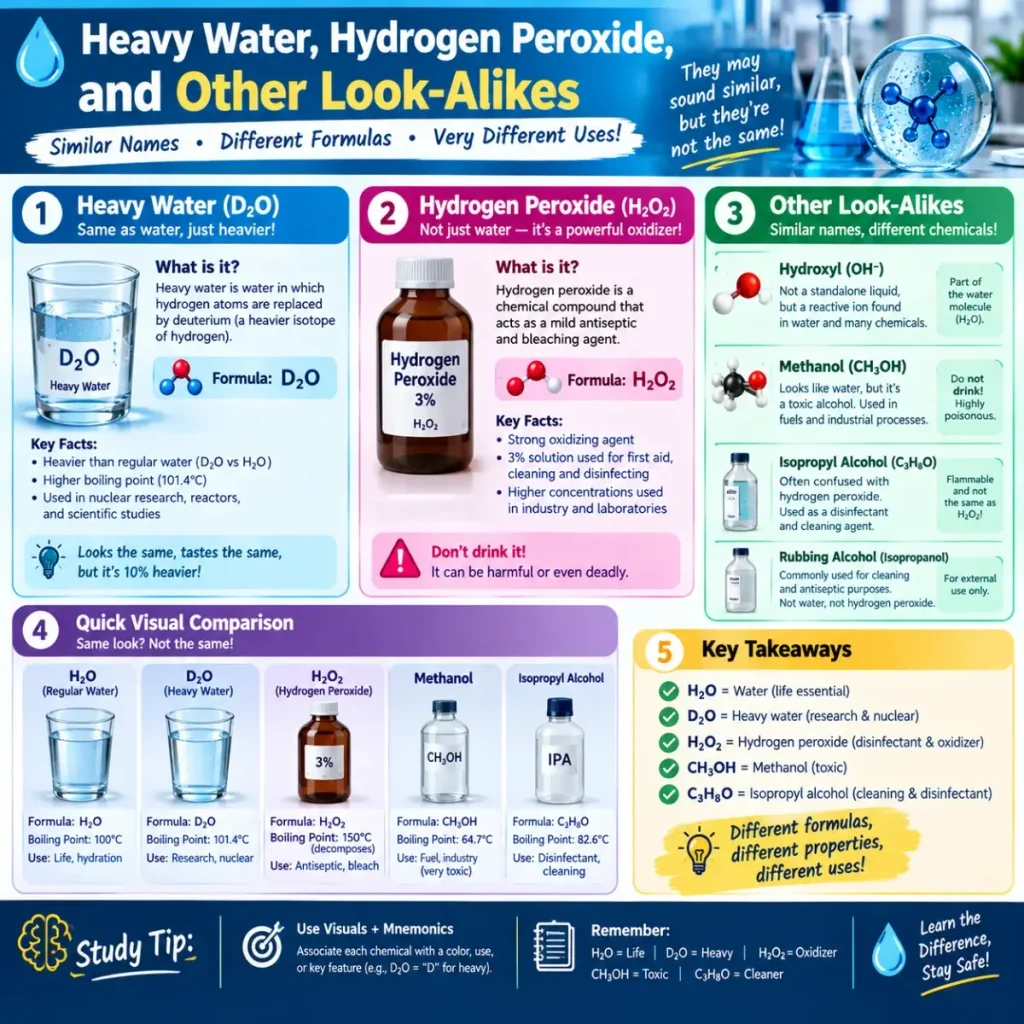
- 🐬 Heavy water is deuterium oxide, written as D2O.
- 🌊 Deuterium is a hydrogen isotope with an extra neutron.
- 💧 Heavy water looks like ordinary water but is denser.
- 🌟 Hydrogen peroxide has the formula H2O2, so it is not water.
- ⭐ Hydrogen peroxide has an extra oxygen atom compared with water.
- 🌿 Hydronium, H3O+, is a positively charged ion found in acidic water.
- 🍀 Hydroxide, OH−, is a negatively charged ion linked to basic solutions.
- 🌈 Pure water contains tiny amounts of both hydronium and hydroxide ions.
- 🌻 Hydrogen sulfide, H2S, smells like rotten eggs and differs from water.
- 💖 Carbon dioxide dissolved in water forms carbonic acid in small amounts.
- 🐚 Seawater contains dissolved salts, so it is not pure H2O.
- 🌊 Brine is water with a high concentration of dissolved salt.
- 💧 Saline is a salt-water solution used in many medical settings.
- 🌿 Sterile water is purified water prepared for medical or lab use.
- ⭐ Always check labels, because similar names can describe very different substances.
🌻 Everyday Names for Different Types of Water
- 🌻 Tap water comes from municipal supplies and is treated for safety.
- 💧 Bottled water is packaged for convenience and sold in many sizes.
- 🌊 Spring water flows naturally from underground sources to the surface.
- 🌟 Mineral water contains naturally dissolved minerals that shape its taste.
- ⭐ Sparkling water carries dissolved carbon dioxide, which creates tiny bubbles.
- 🌿 Distilled water is boiled into steam, then condensed back into liquid.
- 🍀 Purified water has had impurities removed through filtration or similar processes.
- 🌈 Deionized water is stripped of mineral ions, often used in laboratories.
- 💖 Rainwater falls from clouds and collects in barrels, ponds, and lakes.
- 🐬 Well water is drawn from underground and may need testing.
- 🐚 Hard water has more dissolved calcium and magnesium than soft water.
- 🌊 Soft water contains fewer minerals and often feels slicker on skin.
- 💧 Seawater is salty ocean water that is not suited for drinking.
- 🌿 Brackish water is a mix of fresh and salty water.
- ⭐ Alkaline water is marketed with a higher pH than ordinary drinking water.
🌊 Water States and Their Scientific Names
- 🌊 Liquid water is the form most people drink and use.
- 💧 Ice is solid water, formed when liquid water freezes.
- 🌟 Water vapor is the invisible gas form of water.
- ⭐ Steam usually describes hot water vapor and the mist it forms.
- 🌿 Evaporation turns liquid water into vapor below its boiling point.
- 🍀 Condensation turns water vapor back into liquid droplets.
- 🌈 Freezing turns liquid water into ice at zero degrees Celsius.
- 🌻 Melting turns ice back into liquid water at zero degrees Celsius.
- 💖 Sublimation turns ice directly into vapor without becoming liquid.
- 🐬 Deposition turns vapor directly into frost or ice crystals.
- 🐚 Supercooled water stays liquid below its normal freezing point.
- 🌊 Dew forms when water vapor condenses on cool surfaces.
- 💧 Fog is tiny water droplets floating near the ground.
- 🌿 Clouds are collections of tiny water droplets or ice crystals.
- ⭐ Precipitation includes rain, snow, sleet, and hail falling from clouds.
- 🌟 Each state keeps the same chemical formula, H2O.
Medical Disclaimer: The next sections explain water pill names for general education only. They are not medical advice, a diagnosis, or a treatment plan, and they give no dosing instructions. Always speak with a doctor or pharmacist before starting, changing, or stopping any medicine.
⭐ Water Pill Names: What Diuretics Are
- ⭐ Water pills are medicines called diuretics that increase urine production.
- 💧 Diuretics help the kidneys remove extra salt and fluid.
- 🌊 Doctors may prescribe them for high blood pressure, heart failure, and swelling.
- 🌟 Swelling from excess fluid is called edema.
- 🌿 The main classes include thiazide, loop, and potassium-sparing diuretics.
- 🍀 Carbonic anhydrase inhibitors form a smaller, weaker class of diuretics.
- 🌈 Some over-the-counter products offer only a mild diuretic effect.
- 🌻 Pamabrom is an example found in some over-the-counter water capsules.
- 💖 Generic names are the drug names, while brand names are marketing names.
- 🐬 A pharmacist can explain the generic and brand name on any label.
- 🐚 Each class works on a different part of the kidney.
- 🌊 Class differences affect strength, side effects, and the conditions treated.
- 💧 Water pills are not the same as drinking more water.
- 🌿 Diuretics are among the most commonly prescribed medicines.
- ⭐ Only a healthcare professional can decide which water pill fits.
🌟 Water Pill Names: Thiazide and Loop Diuretics
- 🌟 Hydrochlorothiazide is a very well-known thiazide-type water pill.
- 💧 Chlorthalidone is a thiazide-like diuretic often used for blood pressure.
- 🌊 Chlorothiazide is another thiazide-class diuretic listed by medical libraries.
- ⭐ Indapamide is a thiazide-like option mentioned by clinical sources.
- 🌿 Metolazone is another thiazide-type diuretic listed in clinical references.
- 🍀 Thiazide diuretics are common first-choice water pills for hypertension.
- 🌈 Furosemide is the most frequently prescribed loop diuretic.
- 🌻 Furosemide brand names include Lasix, Furoscix, and Lasix ONYU.
- 💖 Bumetanide is a loop diuretic sold as Bumex or Enbumyst.
- 🐬 Torsemide is sold under brand names Demadex and Soaanz.
- 🐚 Ethacrynic acid, sold as Edecrin, is a less common loop diuretic.
- 🌊 Ethacrynic acid is typically reserved for people with sulfa allergy.
- 💧 Loop diuretics act on the loop of Henle in the kidney.
- 🌿 Loop and thiazide types can lower potassium, so blood tests may help.
- ⭐ MedlinePlus says furosemide treats high blood pressure and fluid retention.
💖 Potassium-Sparing and Other Water Pill Names
- 💖 Potassium-sparing diuretics help remove fluid without wasting as much potassium.
- 💧 Spironolactone is a potassium-sparing diuretic sold as Aldactone.
- 🌊 Spironolactone is also called a mineralocorticoid receptor antagonist.
- 🌟 Eplerenone is another potassium-sparing diuretic and receptor blocker.
- ⭐ Amiloride is a potassium-sparing diuretic that works in the kidney.
- 🌿 Triamterene is another potassium-sparing diuretic that doctors may prescribe.
- 🍀 Some tablets combine triamterene with hydrochlorothiazide in one pill.
- 🌈 Combination pills aim to balance potassium effects between two diuretic types.
- 🌻 Potassium-sparing types can raise potassium, so monitoring is important.
- 🐬 Acetazolamide is a carbonic anhydrase inhibitor and a relatively weak diuretic.
- 🐚 Mannitol is an osmotic diuretic, with brand names like Osmitrol.
- 🌊 Urea is also listed among miscellaneous diuretics in drug references.
- 💧 Pamabrom brands include Aqua-Ban and Diurex Water Capsules.
- 🌿 Over-the-counter products may still interact with medicines or health conditions.
- ⭐ Ask a pharmacist before combining any diuretic with other medicines.
🌿 Safety Notes Before Using Water Pills
- 🌿 Never start, change, or stop a water pill without medical advice.
- 💧 Stopping a water pill can allow extra fluid to return.
- 🌊 Frequent urination is an expected effect of water pills.
- 🌟 Dizziness or lightheadedness should be discussed with a healthcare professional.
- ⭐ Dehydration is a risk, especially during illness, heat, or heavy sweating.
- 🍀 Some water pills can change potassium, sodium, and other mineral levels.
- 🌈 Doctors may order blood tests to monitor kidney function and electrolytes.
- 🌻 Report muscle cramps, weakness, or irregular heartbeat to a clinician promptly.
- 💖 Tell your doctor about all medicines, supplements, and herbal products.
- 🐬 People with a sulfa allergy should tell their doctor before treatment.
- 🐚 Water pills are not a safe shortcut for weight loss.
- 🌊 Pregnant or breastfeeding patients should ask a clinician before using any diuretic.
- 💧 Older adults may be more sensitive to fluid and mineral changes.
- 🌿 Seek urgent care for fainting, severe weakness, or very little urine.
- ⭐ This guide is general information and cannot replace personal medical care.
🍀 Study Tips for Remembering Water’s Names and Diuretic Classes
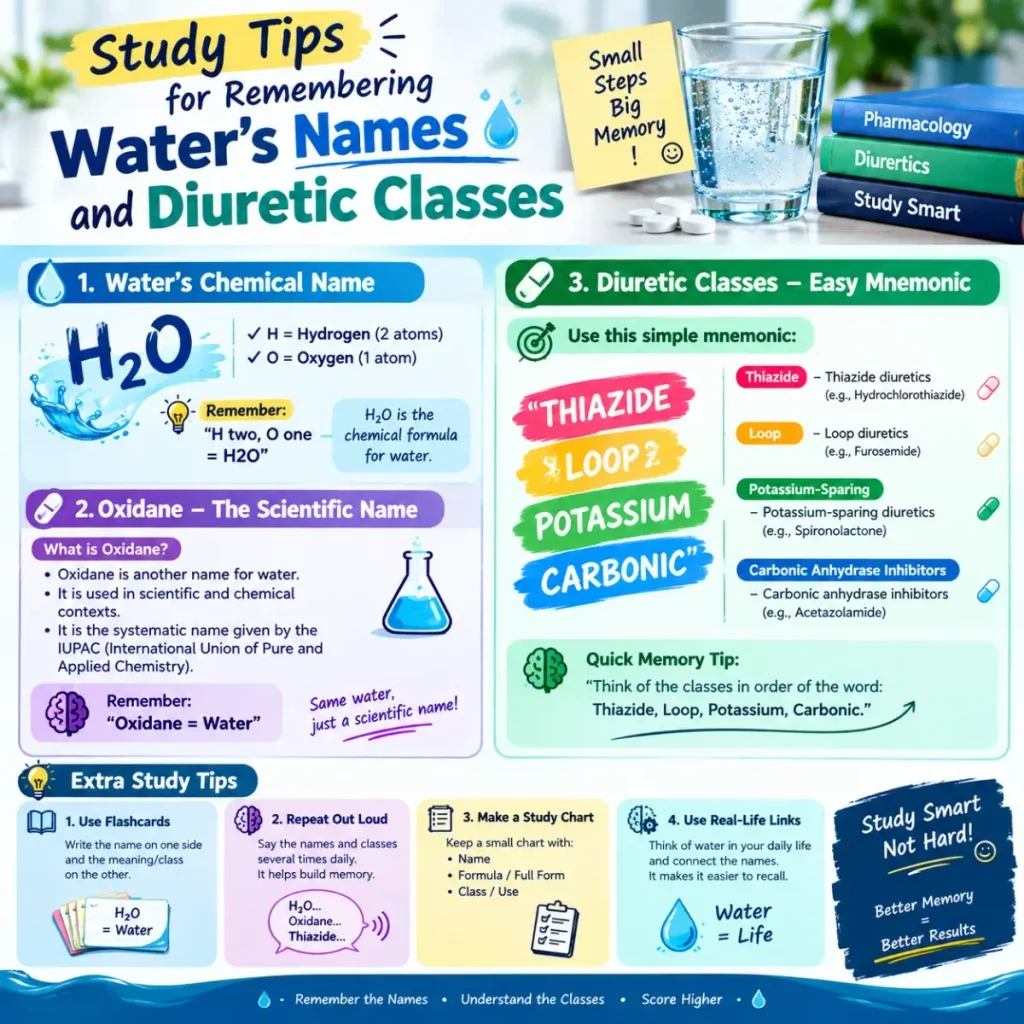
- 🍀 Remember that H2O means two hydrogens and one oxygen.
- 💧 Link di with two and mono with one.
- 🌊 Use flashcards for oxidane, hydrogen oxide, and dihydrogen monoxide.
- 🌟 Draw the bent water molecule to remember its shape.
- ⭐ Practice writing D2O and H2O2 to avoid mixing them up.
- 🌿 Group water types by source, treatment, and mineral content.
- 🌈 For diuretics, learn three classes: thiazide, loop, and potassium-sparing.
- 🌻 Pair each class with one generic example.
- 💖 Match generic names with brand names, like furosemide and Lasix.
- 🐬 Use mnemonics, but verify drug facts in trusted references.
- 🐚 Create a table comparing class, example, and key caution.
- 🌊 Review official sources such as MedlinePlus for drug facts.
- 💧 Teach the topic aloud to a friend to test understanding.
- 🌿 Quiz yourself weekly until the names feel automatic.
- ⭐ Keep notes updated, since drug labels and guidelines can change.
FAQs
What is the chemical name for water?
The everyday chemical name is water, with the formula H2O. Systematic names include oxidane, hydrogen oxide, and dihydrogen monoxide.
What is the H2O water chemical name and formula?
H2O shows two hydrogen atoms bonded to one oxygen atom. Chemists may call it hydrogen oxide or oxidane, but water remains the most common name.
Is dihydrogen monoxide dangerous?
No. Dihydrogen monoxide is just another name for water. The scary wording is a famous joke that makes ordinary water sound alarming.
What is heavy water?
Heavy water is deuterium oxide, written D2O. It contains a heavier hydrogen isotope, so it is a different compound from ordinary water.
What are common water pill names?
Water pills are diuretics, including furosemide (Lasix), bumetanide (Bumex), hydrochlorothiazide, chlorthalidone, and spironolactone (Aldactone). A doctor or pharmacist should guide any use.
Are water pills safe to take without a doctor?
No. Water pills can change fluid and mineral levels, so they should be used only under medical guidance. Ask a doctor or pharmacist before taking any diuretic.
Conclusion
The chemical name for water is simple in daily life and surprisingly rich in science, from H2O to oxidane, hydrogen oxide, and the famous joke name dihydrogen monoxide. This guide covered formulas, structure facts, look-alike compounds, everyday water types, water states, and the main water pill classes with clear safety reminders.
Use the chemistry sections for quick study help, read labels carefully, and always speak with a healthcare professional about any medication. A little knowledge about naming makes science easier to trust and share.

Jack Sullivan is a passionate writer and content creator who loves exploring unique names, creative ideas, and interesting stories. He creates engaging, helpful, and easy-to-read content for NameZeria.com.