
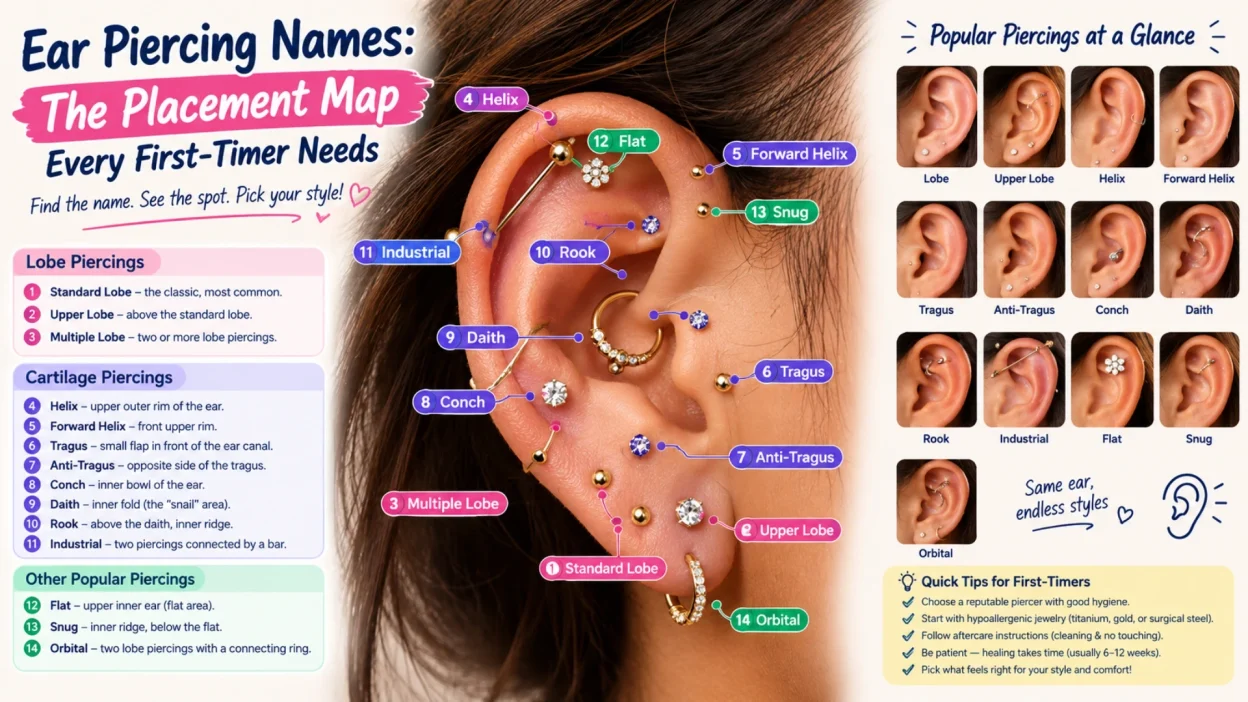
Ear piercing names can be confusing. Studios use different terms for the same spot, and half the names sound like they belong in a medical textbook. If you’ve ever pointed at your ear and said “I want that one” because you didn’t know what it was called, you’re not alone.
This guide fixes that. You’ll get a clear placement map, a pain scale for every piercing, real healing times, and the exact words to use at the studio. Plus, we’ll tell you which piercings to avoid—and why.
By the end, you’ll know exactly what to ask for, what to expect, and how to care for it.
🗺️ Ear Piercing Placement Map (Start Here)
Before we get into names, here’s where each piercing actually sits on your ear. Use this as your visual guide.
| Placement | Where It Is |
|---|---|
| Lobe | Soft, fleshy bottom part of the ear |
| Upper Lobe | Slightly higher on the fleshy part, before cartilage |
| Helix | Upper outer rim of cartilage |
| Forward Helix | Front curve of cartilage, closer to your face |
| Tragus | Small bump of cartilage in front of the ear canal |
| Anti-Tragus | Bump opposite the tragus, above the lobe |
| Conch | Deep bowl-shaped area in the middle of the ear |
| Daith | Innermost fold of cartilage above the ear canal |
| Rook | Ridge of cartilage in the upper inner ear |
| Snug | Ridge separating the outer ear from the inner bowl |
| Flat | Flat area of cartilage in the upper ear |
📊 Pain Scale & Healing Time: Every Ear Piercing Compared
This is the table most guides won’t give you. Pain is subjective, but these numbers are based on common experiences. Healing times are averages—your body may heal faster or slower.
Key takeaway: Lobe piercings heal in weeks. Cartilage piercings take months. Plan accordingly.
| Piercing Name | Pain Level (1–10) | Healing Time | Best For |
|---|---|---|---|
| Standard Lobe | 2 | 6–8 weeks | First-timers |
| Upper Lobe | 3 | 6–8 weeks | Curated looks |
| Stacked Lobe | 3 | 6–8 weeks | Layered styling |
| Transverse Lobe | 4 | 8–12 weeks | Bold lobe look |
| Helix | 4 | 6–9 months | Beginners |
| Forward Helix | 5 | 6–9 months | Anatomy-dependent |
| Tragus | 5 | 6–12 months | Small studs |
| Anti-Tragus | 6 | 8–12 months | Unique placement |
| Conch | 6 | 6–12 months | Statement jewelry |
| Daith | 7 | 6–12 months | Ring/clicker |
| Rook | 6 | 6–12 months | Curved barbell |
| Snug | 8 | 8–12 months | Experienced only |
| Industrial | 8 | 6–12 months | Bold statement |
👂 Lobe Piercings: The Starting Point
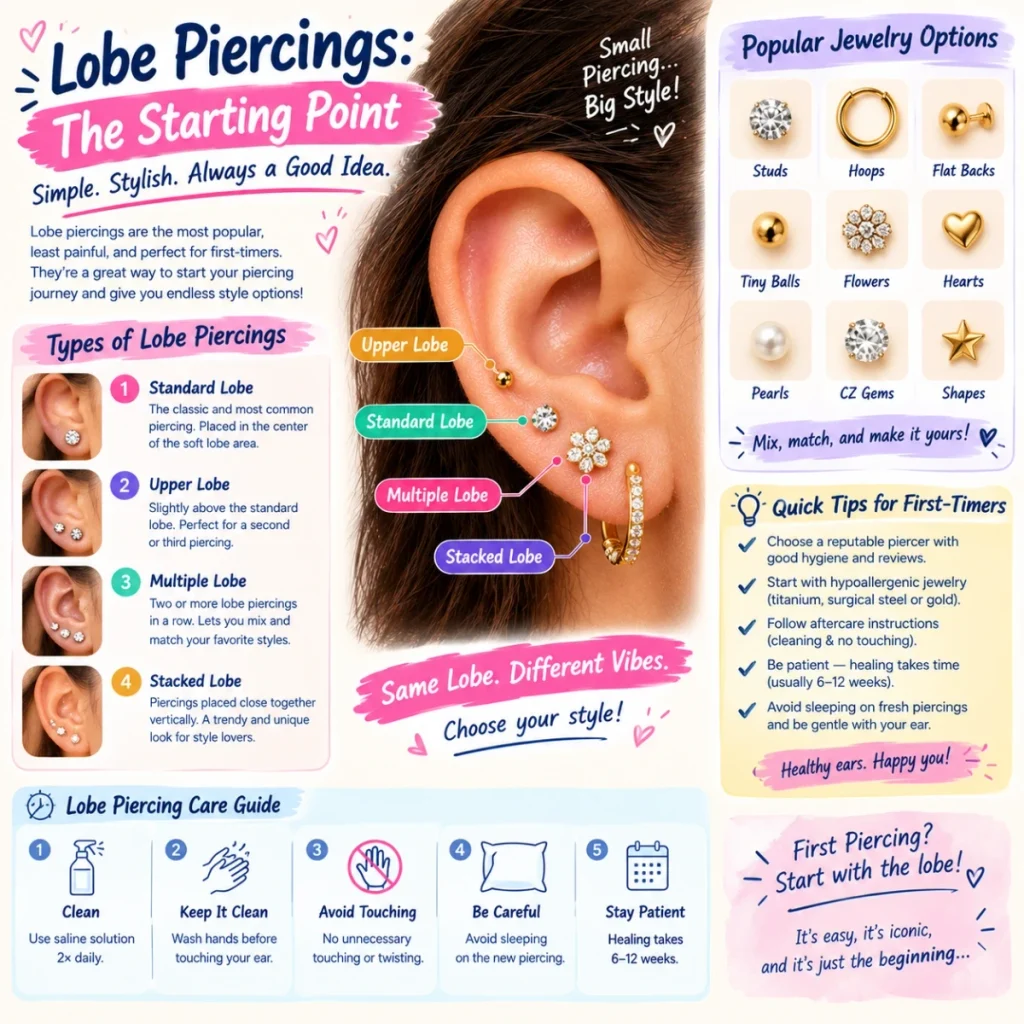
Lobe piercings are where almost everyone begins. They go through the soft, fleshy part of the lower ear, which is why they’re the least painful and heal the fastest.
Standard Lobe
This is the classic first piercing. It goes through the center of your earlobe. Healing usually takes about 6 to 8 weeks, though some studios say 2 to 3 months . It’s the easiest piercing to care for and can wear almost any jewelry style once healed.
Upper Lobe
An upper lobe is placed slightly higher on the fleshy part, just before the cartilage begins . It’s a good stepping stone if you want more than one piercing but aren’t ready for cartilage yet.
Stacked Lobe
A stacked lobe is when you have two or more piercings placed vertically on top of each other rather than in a row going up the edge . This creates a curated, layered look and is a popular trend right now.
Transverse Lobe
Instead of going front-to-back, this piercing goes horizontally through your lobe from side to side. A barbell connects the two holes. Because it doesn’t go through cartilage, it’s generally less painful than other piercings .
🦴 Cartilage Piercings: The Main Placements
Cartilage piercings take much longer to heal than lobes—often 6 months to a year or more—because cartilage has less blood flow . Here are the names you need to know.
Helix
The helix is the upper outer rim of your ear cartilage . It’s usually the first cartilage piercing people get after their lobes. You can get a single, double, or triple helix. Healing takes roughly 6 to 9 months, sometimes up to a year .
Forward Helix
This is the same idea as a helix, but placed on the front curve of cartilage closer to your face, just above the tragus . People often get two or three in a row here. It’s more anatomy-dependent, so a piercer will need to check if your ear shape works for it .
Tragus
The tragus is the small, thick bump of cartilage directly in front of your ear canal . It’s a popular spot for a small stud or hoop. Be aware that you won’t be able to wear earbud headphones comfortably while it heals .
Anti-Tragus
This is the bump of cartilage opposite the tragus, sitting just above your lobe . It’s less common than the tragus and can be more painful and slower to heal because the tissue is dense .
Conch
The conch is the deep “bowl” or cup-shaped area in the middle of your ear . An inner conch piercing goes through the bowl itself, while an outer conch goes through the flat rim around it . It’s often considered one of the easier cartilage piercings to heal, though it still takes months .
Daith
The daith is the innermost fold of cartilage just above your ear canal . It’s known for being a thicker, more painful piercing, but it looks great with a ring or clicker that faces forward . Some people claim it helps with migraines, though that’s anecdotal.
Rook
The rook is the ridge of cartilage in the upper inner ear, above the daith . It’s usually pierced with a curved barbell or a small hoop. It requires specific anatomy to work well.
Snug (Anti-Helix)
The snug goes through the ridge of cartilage that separates the outer ear from the inner conch bowl . It’s notoriously difficult to heal because the tissue is dense and the piercing is easily irritated by sleeping or headphones .
Flat
The flat is the flat area of cartilage in the upper ear, between the helix and the forward helix . It’s a good canvas for statement studs and is less curved than other placements.
🔗 Specialty & Combination Piercings
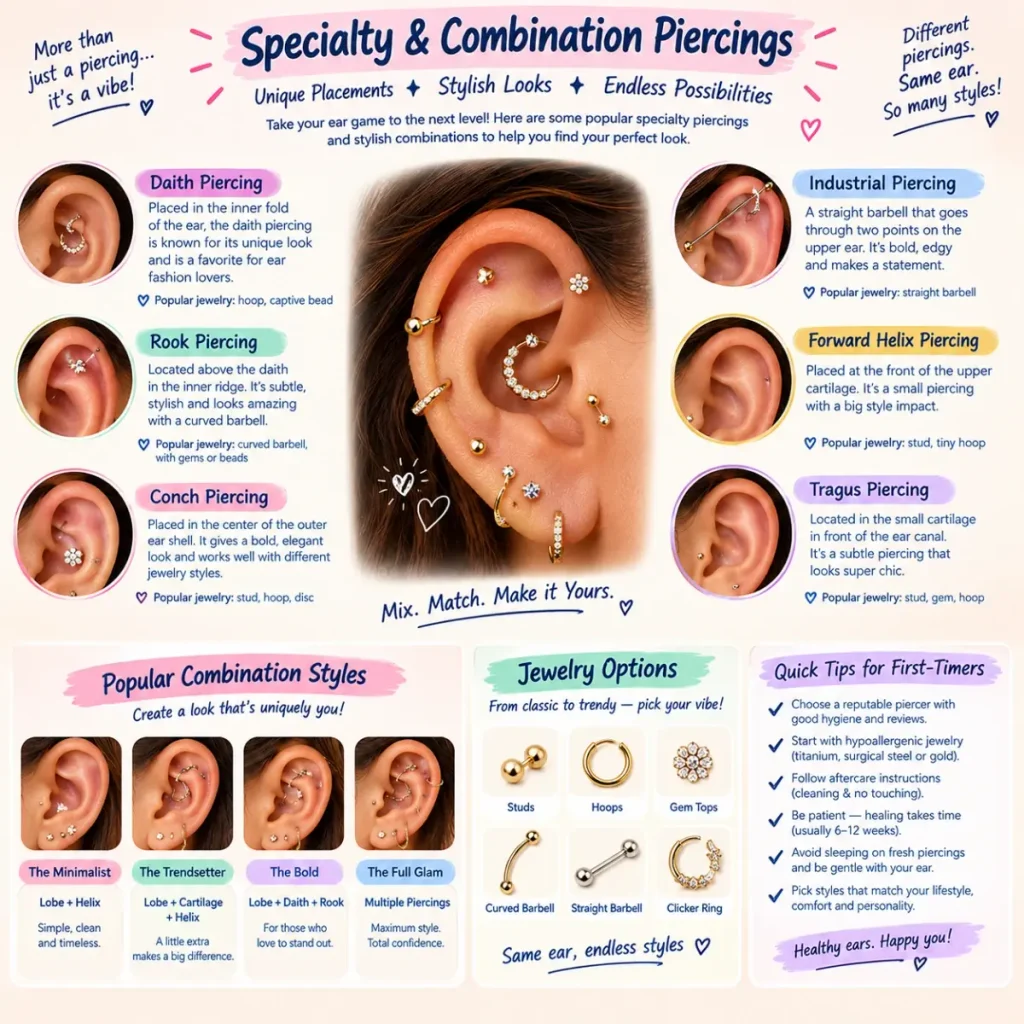
These aren’t single placements but styles that connect multiple holes or create a specific effect.
Industrial
An industrial is two separate piercings (usually through the forward helix and the helix) connected by a single long barbell . It’s a bold look and can be tricky to heal because the two holes pull against each other.
Orbital
An orbital is when a single piece of jewelry (usually a ring) passes through two separate holes in the same area of the ear . It’s commonly done on the lobe but can be placed elsewhere.
Constellation
A constellation piercing is a curated cluster of multiple small studs arranged to look like stars or a constellation . It’s not a single piercing type but a styling choice that uses several placements together.
⚠️ Piercings to Avoid (And Why)
Not every piercing is right for every person. These are the ones that cause the most trouble—either because they’re hard to heal or because they interfere with daily life.
Hard-to-Heal Piercings
- Snug — Dense tissue, easily irritated by sleeping or headphones. Many people give up before it heals.
- Industrial — Two holes pull against each other. Healing can be unpredictable.
- Anti-Tragus — Thick tissue, slow healing. Requires patience.
Piercings That Interfere with Daily Life
- Tragus — You can’t wear earbuds comfortably while it heals. If you work with headphones, skip this one.
- Daith — Same issue with earbuds. Also harder to clean.
- Conch — You can’t sleep on that side for months. Side sleepers, beware.
🧪 What to Say at the Studio
Knowing the names is only half the battle. Here’s how to communicate with your piercer so you get exactly what you want.
- Point to the spot on your ear — don’t rely on names alone. Anatomy varies, and what looks like a helix on one person might be a flat on another.
- Ask if your anatomy works for that placement — some piercings require specific ear shapes.
- Confirm the jewelry type — stud, hoop, or barbell. Each has different healing implications.
- Ask about healing time and aftercare — get it in writing if possible.
- Never get cartilage pierced with a gun — always a needle. Guns can shatter cartilage.
❓ Frequently Asked Questions
👂 What is the most painful ear piercing?
The snug and daith are often cited as the most painful because they go through thick, dense cartilage . The anti-tragus can also be quite painful. Lobe piercings are the least painful.
⏱️ Which ear piercing heals the fastest?
Standard lobe piercings heal the fastest, typically in 6 to 8 weeks . Cartilage piercings take much longer—usually 6 months to a year or more.
🦴 What is a helix piercing?
A helix piercing is any piercing along the upper outer rim of your ear cartilage . It’s the most common cartilage piercing and can be done once, twice, or three times in a row.
🎯 What is the difference between a conch and a daith?
The conch is the large bowl-shaped area in the middle of your ear, while the daith is the small inner fold of cartilage above your ear canal . They’re different placements with different healing experiences.
🛌 Can I sleep on my side after getting a piercing?
Not on the side you pierced. You’ll need to sleep on the opposite side or use a travel pillow with a hole in the middle to avoid pressure on the healing piercing.
🎧 Can I wear earbuds with a new piercing?
It depends on the placement. Tragus and daith piercings make earbuds uncomfortable or impossible while healing. Helix and lobe piercings generally don’t interfere with earbuds.
🔄 Do ear piercings close up if I take them out?
Lobe piercings can close quickly if you remove jewelry before they’re fully healed, and sometimes even after. Cartilage piercings may close or shrink, but many people find that the hole remains open or can be re-stretched after healing.
💍 What jewelry is best for a new piercing?
Implant-grade titanium is the gold standard. It’s hypoallergenic, lightweight, and least likely to cause irritation. Avoid cheap metals, which can cause infections and delays in healing.
🎀 Conclusion
Ear piercing names don’t have to be confusing. Once you know the placement map, the pain scale, and the healing times, you can walk into any studio and ask for exactly what you want.
Start with your lobes if you’re new. Move to cartilage when you’re ready for a longer healing journey. And always—always—go to a professional piercer who uses a needle, not a gun.
Take your time, choose a placement that fits your lifestyle, and follow your aftercare instructions. Your ears will thank you. 👂✨

Jack Sullivan is a passionate writer and content creator who loves exploring unique names, creative ideas, and interesting stories. He creates engaging, helpful, and easy-to-read content for NameZeria.com.