Old Norse Names
Meanings, origins and the stories behind the names the Vikings really used.
Bjorn means “bear.”Show another name
Old Norse names are short, strong and full of meaning. They were spoken across Scandinavia and the lands the Norse settled, and many of them still live on today in names like Astrid, Leif and Sigurd. This guide explains how Old Norse names worked, lists the top 10 you can use today, and covers boy names, girl names, god names, Viking nicknames and even Norse names for pets. It written for parents, writers, gamers and anyone who simply loves the sound of the North.
Old Norse names at a glance
Short on time? This table summarizes the whole article, and each row points to the section where you can read more.
| Topic | Key point | Example |
|---|---|---|
| How names worked | One given name, a patronymic and often a nickname. No fixed surnames. | Ragnar Sigurdsson |
| Top 10 names | The most popular and meaningful names to use today | Freya, Bjorn, Astrid |
| Boy names | Often about war, wolves, bears and helmets | Hjalmar, Ulf, Einar |
| Girl names | Often about beauty, battle, life and wisdom | Helga, Liv, Saga |
| God names | Names drawn from Norse mythology | Odin, Thor, Frigg |
| Name building blocks | Two word parts joined together | sigr + friðr = Sigrid |
| Nicknames | Used to tell people with the same name apart | Ivar the Boneless |
| Pet names | Mythical animals and places make great pet names | Fenrir, Sleipnir, Huginn |
What are Old Norse names?
Historians know more male names than female names because men appear more often in written sources and travel records. That is why lists of Old Norse names usually lean toward boys, and why girl names often come from goddesses and the sagas.
How Old Norse naming worked
The Norse did not use surnames the way we do. A person was usually known by a single given name plus a patronymic, which means “son of” or “daughter of” the father. Ragnar, the son of Sigurd, was Ragnar Sigurdsson. A mother’s name could be used , though less often. Iceland still follows this system today, so an Icelandic woman named Sigrun whose father is Gunnar might be Sigrun Gunnarsdóttir.
Because the pool of given names was fairly small, many people shared the same one. Nicknames solved the problem by working as unique identifiers, and that is where names like Ivar the Boneless and Erik the Red came from. Families also loved to reuse the names of grandparents and ancestors, believing that a name carried some of its owner’s luck and strength.
Top 10 Old Norse names
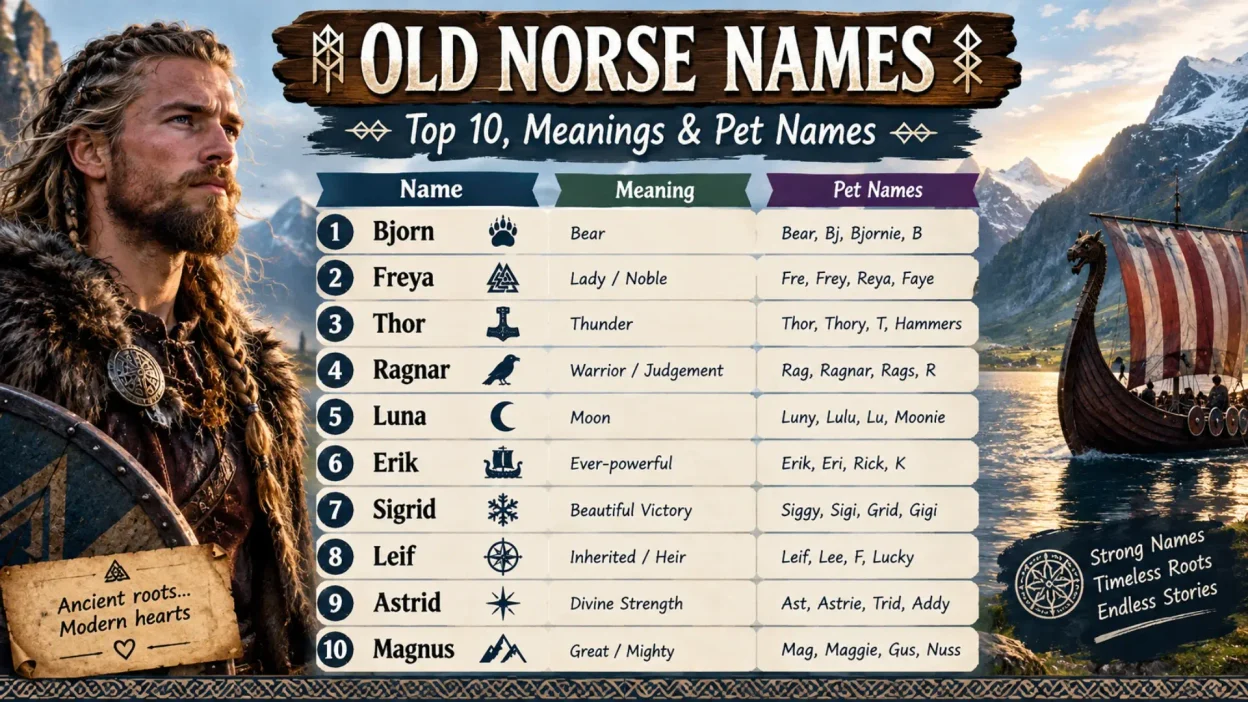
These ten names have been chosen for their history, meaning and modern appeal. Each one is still used today, and each is easy to say.
| Name | Old Norse form | Meaning | Say it like | Best for |
|---|---|---|---|---|
| Freya | Freyja | lady | FRAY-ah | Girl |
| Bjorn | Bjǫrn | bear | BYORN | Boy |
| Astrid | Ástríðr | divinely beautiful | AH-strid | Girl |
| Sigurd | Sigurðr | victory guardian | SEE-gurd | Boy |
| Ragnar | Ragnarr | counsel and army | RAHG-nar | Boy |
| Thor | Þórr | thunder | THOR | Boy |
| Leif | Leifr | heir, descendant | LAYF | Boy |
| Gunnar | Gunnarr | bold warrior | GUN-nar | Boy |
| Solveig | Sǫlveig | sun strength | SOHL-vay | Girl |
| Dagny | Dagný | new day | DAHG-nee | Girl |
Notice that many Old Norse forms end in “r.” That ending marked the nominative case in Old Norse grammar, and most modern versions simply drop it, so Gunnarr became Gunnar and Bjǫrn became Bjorn.
Old Norse boy names
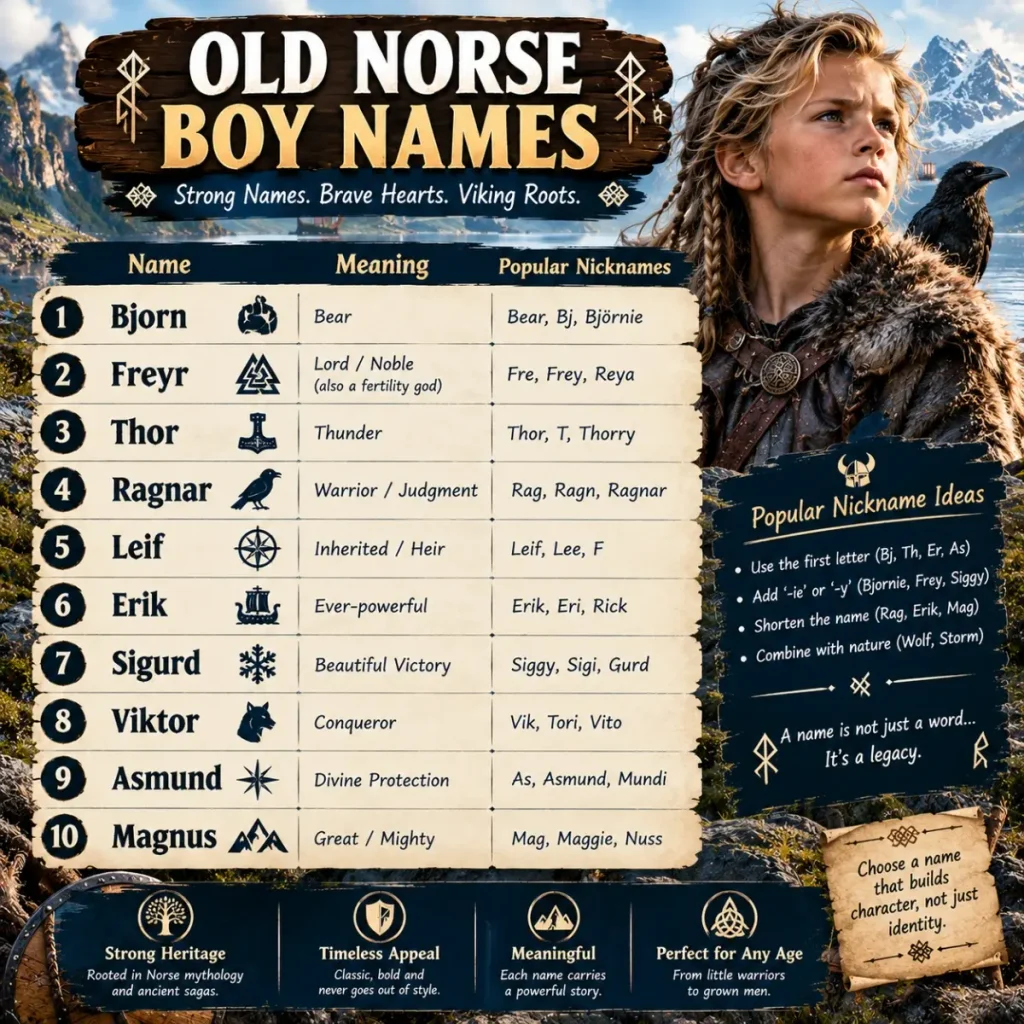
Boy names often mention animals, weapons and rulers, and they were meant to give their owners courage.
- Einar means lone warrior.
- Hjalmar means helmeted warrior.
- Arne means eagle.
- Eirik means eternal ruler.
- Ivar means bow warrior.
- Olaf means ancestor’s descendant.
- Halldor means rock of Thor.
- Ulf means wolf.
- Harald means army ruler.
- Thorstein means Thor’s stone.
- Birger means to help or rescue.
- Erland means foreigner.
Old Norse girl names
Girl names often celebrate beauty, battle, life and wisdom. Many come straight from the goddesses and heroines of the sagas.
- Helga means holy or blessed.
- Hildr means battle.
- Liv means life.
- Runa means secret lore or rune.
- Saga means seeress or story.
- Sigrid means beautiful victory.
- Brynhild is a heroine of Norse legend, linked to armor and battle.
- Gudrun is a famous saga heroine whose name suggests divine secret lore.
- Asa means goddess.
- Idun is the goddess of youth and apples.
- Eir means help and protection.
Norse god and mythology names
Gods and goddesses gave the Norse language some of its most famous names. These work well for children, characters and pets alike.
- Odin is the chief god, tied to wisdom, poetry and war.
- Thor is the god of thunder and strength.
- Loki is the clever trickster, and the origin of his name is still debated.
- Freyr means lord and is a god of fertility and peace.
- Freyja means lady and is a goddess of love and magic.
- Frigg is the queen of the gods and a patron of family.
- Tyr is the brave god of law and war.
- Baldur is the beloved god of light.
- Heimdall is the watchman of the gods.
- Mimir means wise one.
How Old Norse names are built
Many Old Norse names are made from two small word parts. Once you know the parts, you can read a name like a sentence, or build your own. Astrid joins áss (god) with fríðr (beautiful), and Sigurd joins sigr (victory) with varðr (guardian). Common building blocks include:
- sigr means victory.
- hildr means battle.
- gunnr means war.
- hjalmr means helmet.
- bjǫrn means bear.
- ulfr means wolf.
- ǫrn means eagle.
- áss means god.
- rún means secret lore.
- dagr means day.
Famous Viking nicknames
If you thought the names were fun, wait until you meet the nicknames. They described looks, deeds or quirks, and some were famously unflattering. Ragnar Lothbrok’s name points to his shaggy trousers. Ivar the Boneless and Sigurd Snake-in-the-Eye are known from legend, Erik the Red is remembered for his hair or temper, and Leif the Lucky explored far across the ocean. Harald Bluetooth became king of Denmark, and one chronicle even records a man called Eystein Foul-Fart.
To make your own Viking name, combine a given name, a patronymic and a nickname. Try “Astrid Leifsdottir the Bright” or “Bjorn Ulfsson Stormcaller.” The best nicknames are short, visual and a little bit funny.
Old Norse pet names
Norse myth is full of wolves, ravens, cats and horses, so it is a goldmine for pet names. Browse our pet names, dog names and cat names for even more ideas.
- Fenrir is the giant wolf, perfect for a big dog.
- Geri and Freki are Odin’s two wolves, ideal for a pair of dogs.
- Huginn and Muninn are Odin’s ravens, whose names mean thought and memory, perfect for birds or clever cats.
- Freya suits a cat, because the goddess Freyja rode in a chariot pulled by cats.
- Nott means night and is a lovely name for a black cat.
- Ratatoskr is the squirrel who runs up the world tree, a fun name for a hamster or squirrel.
How to pronounce and spell Old Norse names
Old Norse used a few letters that English does not. The letter þ (thorn) sounds like the “th” in “thin,” and ð (eth) sounds like the “th” in “this.” The letter ǫ sounds like a rounded “o,” and á, é, í, ó and ú are long vowels. Most people simply use modern spellings, such as Thor instead of Þórr, which is perfectly fine for baby names, books and games. If you want an authentic touch, keep one special letter, like the ð in Sigurd or the ö in Björn.
How to choose an Old Norse name
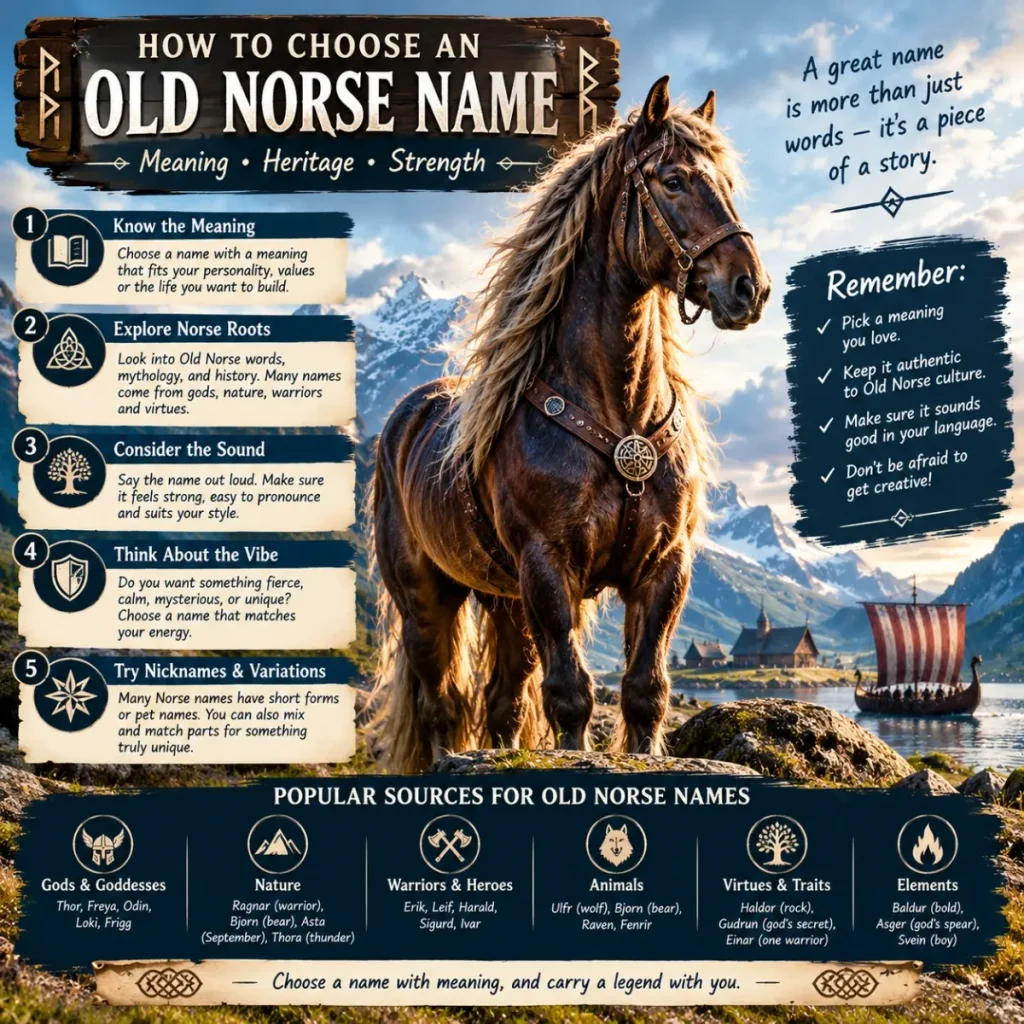
Start with the meaning, because the Norse cared about it. Pick a name that fits the personality you hope for: Bjorn for strength, Liv for joy, Saga for story. Then say it aloud with the family name to check how it sounds. For a character or a game, choose a name with a clear image, and for a pet, pick something short that can be called across a park. Finally, check the spelling, because Old Norse names have many modern forms and each country has its own favorite.
Old Norse names in books, shows and games
Old Norse names have never been more visible. Television series about the Vikings made names like Ragnar, Bjorn and Ivar familiar to millions, and fantasy games and novels borrow Norse sounds for heroes, kingdoms and magic. Writers often mix real names with invented ones by using the building blocks above. A warrior called Hildulf (“battle wolf”) or a seer named Runhild (“secret battle”) sounds authentic because it follows the same rules the Norse used.
Old Norse names in Iceland today
Iceland is the best place to see the old naming system alive. Many Icelanders still use patronymics, so siblings can have different last names, and the country keeps an official list of approved given names so that new names fit the language. This means a modern Icelander can carry a name that would have been familiar a thousand years ago, such as Gunnar, Helga or Sigurður. If you love the Old Norse style, Iceland is a wonderful place to study it.
FAQs
Did Vikings have last names?
No. They used a given name plus a patronymic, such as “Erik’s son,” and sometimes a nickname. Fixed family surnames came much later.
What is the difference between Old Norse names and Viking names?
There is almost no difference in practice. Old Norse is language and Viking names are the names people used in era, the lists overlap heavily.
What does the name Astrid mean?
Astrid comes from Old Norse elements meaning “god” and “beautiful,” so usually translated as “divinely beautiful.”
What are the most popular Old Norse names today?
Freya and Odin are often listed as the most popular Norse baby names, followed by classics like Bjorn, Leif, Astrid and Sigrid.
Why were nicknames so common among Vikings?
Stock given names limited, many people shared one. A nickname made each person easy to identify, and it often described a feature or famous deed.
Is Old Norse still spoken?
No, but modern Icelandic is its closest living relative, and Icelandic speakers can still read many sagas with some effort.
Can I use Old Norse names for pets?
Yes. Names like Fenrir, Freya, Loki and Sleipnir are popular for dogs, cats and horses. See our pet names page for more.
How do I make my own Viking name?
Pick a given name, add your father’s or mother’s name plus “son” or “dottir,” then finish with a nickname that fits you.
Final thoughts
Old Norse names have lasted a thousand years because they are simple, strong and rich in meaning. Whether you are naming a baby, a character or a puppy, pick the one that feels right and enjoy the history that comes with it. For more name ideas, explore PickPun.

Jack Sullivan is a passionate writer and content creator who loves exploring unique names, creative ideas, and interesting stories. He creates engaging, helpful, and easy-to-read content for NameZeria.com.